
Fairtrade sourcing
Sustainable trade and production are no longer a novelty: they reflect consumer demand in mainstream markets. With consumers expecting ever greater transparency, companies and brands are increasingly integrating sustainability into business practices. Fairtrade is a partner on the journey to sustainability, for consumers, businesses, and farmers and workers.

Fairtrade offers two models, both of which yield tangible benefits for producers while complementing the drive for sustainability: There is the classic FAIRTRADE Mark, now with greater clarity about the ingredients behind it, and there is the new Fairtrade Sourced Ingredient model (FSI), with a new mark.
With these models, companies and brands can better offer their customers ethical and transparent options that satisfy their demands for sustainable products. The models aim to enable farmers and workers to sell more of their products on Fairtrade terms, thus improving their living and working conditions, boosting their productivity and income, and reducing damage to the environment.
The FAIRTRADE Mark
If you see the FAIRTRADE Mark with an arrow, look on the back of the packaging to learn more about the ingredients and sourcing method!
This mark is used on products made of several ingredients, like biscuits or ice cream, where all the ingredients that are available under Fairtrade conditions have been certified. For instance, the cocoa, sugar and vanilla of your favourite chocolate bar. The minimum total Fairtrade content is 20 percent but many companies go above and beyond that. You will find the relevant information on the back of the pack.
It is also used on cocoa, sugar, fruit juice and tea that have been sourced using mass balance.
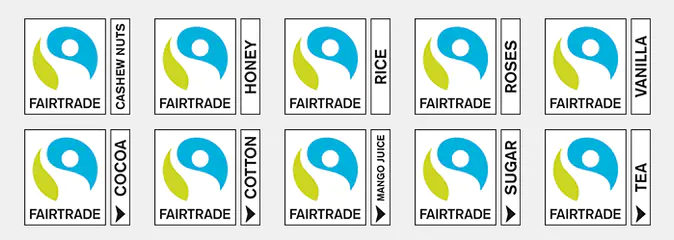
Fairtrade Sourced Ingredient Mark
These white marks indicate that the specific ingredient named on the tab has been sourced as Fairtrade, such as Fairtrade cocoa in a breakfast cereal.
This is different from the black FAIRTRADE Mark, which signifies that all the ingredients that are available as Fairtrade are Fairtrade certified. If the ingredient was sourced using mass balance an additional arrow in a tab indicates this and points to more information on the back of the package. Ingredients with the Ingredient Mark are certified according to the same Fairtrade Standards as the ingredients of products with the black FAIRTRADE mark, and producers still receive all the same benefits.
Want to know what the FAIRTRADE Mark means on a product you bought? Read more about the FAIRTRADE Marks.
Supporting sustainable livelihoods through Fairtrade sourcing
The more producers sell on Fairtrade terms, the more they see tangible benefits for their families and communities. Through fairer prices, the Fairtrade Premium, better terms of trade and more stable contracts, producers are able to take more control of their businesses and invest in their future.
Expanding the ways in which producers can get access to world markets on Fairtrade terms is vital to achieving sustainable livelihoods.
Fairtrade created different sourcing models to do just that. These have been developed with and approved by farmers and workers themselves, thanks to the fact that producers are 50 percent owners of the Fairtrade system through their representation in the General Assembly.
Fairtrade’s certification according to rigorous standards that are independently verified remains the same. And our sourcing models offer ways for companies and brands to source individual ingredients, and give consumers greater choice and transparency of ethically and sustainably sourced products.