Tea is the world’s most popular drink (after water), with about 70,000 cups drunk every second. From its origins as an ancient medicinal crop in China, tea has spread far and wide – many of us simply can’t face the day without a cup.
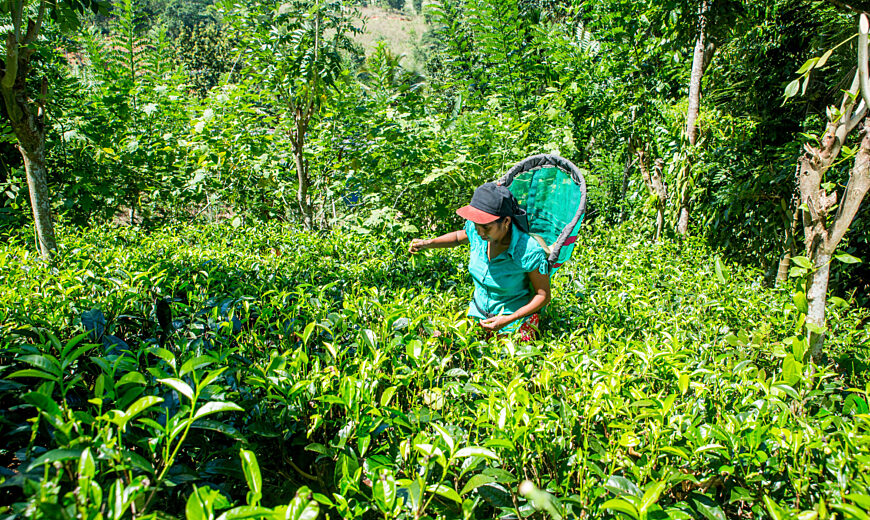
Tea grower picking tea at Small Organic Farmers' Assosciation, Sri Lanka D's STUDIO
The multi-billion dollar tea industry employs millions of people, but working conditions and earnings for the producers are often dire. Fairtrade works with workers on plantations as well as with smallholder farmers to bring Fairtrade tea to consumers around the world.
Choosing Fairtrade tea makes a difference
Fairtrade 'tea' refers to all teas which stem from the leaves and buds of the Camellia sinensis plant. Grown year-round, this is the source of all white tea, green tea, oolong tea, black tea, and pu'erh tea. (Fairtrade also works with herbs and spices, which form the basis of many herbal teas.)
The bulk of global tea production takes places at large plantations. Workers often live on or near the estates where they work, and low wages and poor working conditions are prevalent. Even when national minimum wages are met on a tea estate, there is still a considerable gap between that and living wages, and workers often rely on in-kind benefits.
Small-scale tea farmers often have very small plots and rely on nearby tea estates as their connection to the broader markets, meaning these producers have little leverage with which to improve their incomes.
Fairtrade recognizes these challenges in the tea sector and is committed to bringing about change for tea farmers and workers. Our approach includes the following:
Fairtrade certified producer organizations receive a Fairtrade Minimum Price for their tea, which is adjusted to different regional conditions and production techniques (organic tea, for instance, receives a higher price). This Minimum Price acts as a safety net against sudden price drops that can devastate producers' businesses.
On top of the sales price, producers receive a Fairtrade Premium which they decide together how to invest. Workers at tea estates often spend the Premium on direct benefits for them and their families, such as educational bursaries or credit services, as well as empowerment projects. Farmers use these funds to strengthen their organizations, communities, and agricultural practices.
Fairtrade is part of an international coalition to address the low wages in the tea industry. We are collaborating with several organizations to establish living wage benchmarks for workers on tea estates, with the aim of enabling these producers to lead dignified lives.
Fairtrade also empowers farmers and workers in other ways, whether by opening new export markets for small-scale farmers or supporting estate workers’ participation in collective bargaining so they can strengthen their voice and work with management toward improved wages and conditions.
Tea - Key data about Fairtrade Impact
Would you like to learn how many producer organizations are involved in Fairtrade Tea? Or how many workers and farmers you can find per country? Visit our dedicated page with statistics on our Top 7 product dashboard
In many origins, tea production has roots in the colonial era, with only gradual improvements ever since. It’s time to pick up the pace of reform, and ensure that farmers and workers earn a dignified living from this immensely popular product. When you choose Fairtrade tea, not only do you get a delicious drink, but you also support farmers and workers to push for necessary change in the industry.
Are you a farmer, worker or business interested in Fairtrade certification?
The revised Fairtrade Tea Standard seeks to balance the realities of a challenging global tea market with stronger requirements to protect the rights and working conditions of ...
More than 1,400 small-scale Fairtrade certified cooperatives in 73 countries celebrated this year’s International Day of Cooperatives around the theme of ‘decent work’. Here's why.