- You are here :
- Home
- About Fairtrade
- History of Fairtrade
History of Fairtrade
Below is a brief chronology of Fairtrade and Fairtrade International, showing the key dates.
1988
Launch of the first Fairtrade label, Max Havelaar, under the initiative of the Dutch development agency Solidaridad. The first Fairtrade coffee from Mexico was sold into Dutch supermarkets. It was branded Max Havelaar, after a fictional Dutch character who opposed the exploitation of coffee pickers in Dutch colonies.
Late ‘80s/early ‘90s
The Max Havelaar initiative is replicated in several other markets across Europe and North America: Max Havelaar (in Belgium, Switzerland, Denmark, Norway and France), Transfair (in Germany, Austria, Luxemburg, Italy, the United States, Canada and Japan), Fairtrade Mark in the UK and Ireland, Rättvisemärkt in Sweden, and Reilu Kauppa in Finland.
1997
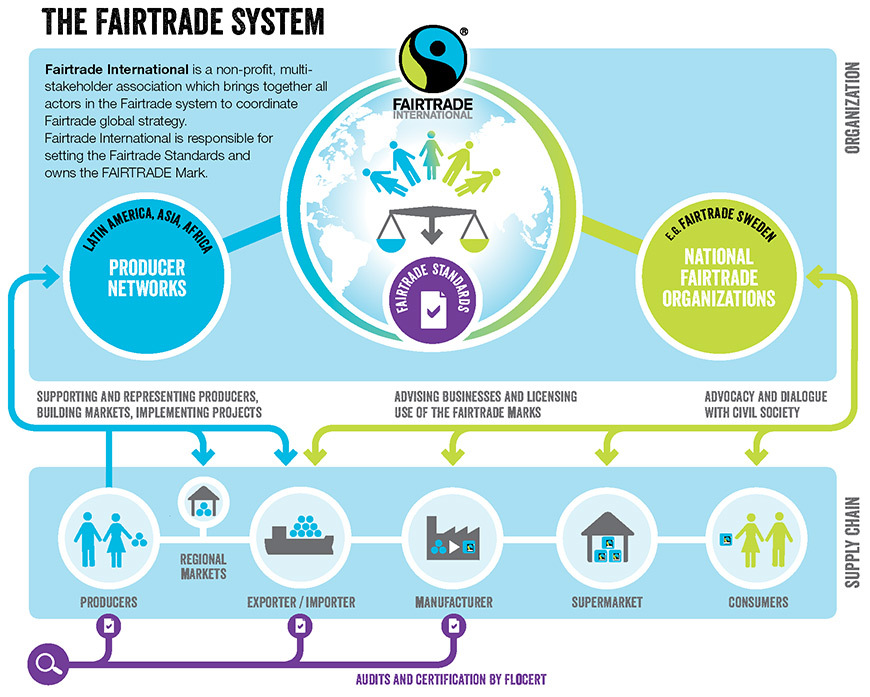
Fairtrade Labelling Organizations International (FLO) was established in Bonn, Germany to unite the labelling initiatives under one umbrella and harmonize worldwide standards and certification.
2002
Fairtrade International launches the international FAIRTRADE Certification Mark. The goals of the launch were to improve the visibility of the Mark on supermarket shelves, facilitate cross border trade and simplify export procedures for both producers and exporters. Producer representatives join the FLO Board of Directors
2004
Fairtrade International splits into two independent organizations: FLO, which sets Fairtrade standards and provides producer support, and FLO-CERT, which inspects and certifies producer organizations and audits traders.
2007
Fairtrade International is recognised by ISEAL as one of seven organizations that have reached the highest standards for defining ethical trade. Global sales increased by 47 percent. Producers become full members/co-owners of FLO.
Now
Standards News
Participate in the consultation about the Hired Labour Standard review! Consultation period running from 6 May to 5 July 2013.