Cocoa

An estimated 14 million people in the developing world depend on cocoa production for their livelihoods

Below you can find out about:

The problems facing cocoa producers

More than 30 developing countries produce cocoa, providing 14 million people with a livelihood

Cocoa is produced, traded and consumed in vast quantities across the globe. While cocoa production occurs within the tropical regions of the developing world, the majority of cocoa manufacturing and consumption occurs within the developed world. 

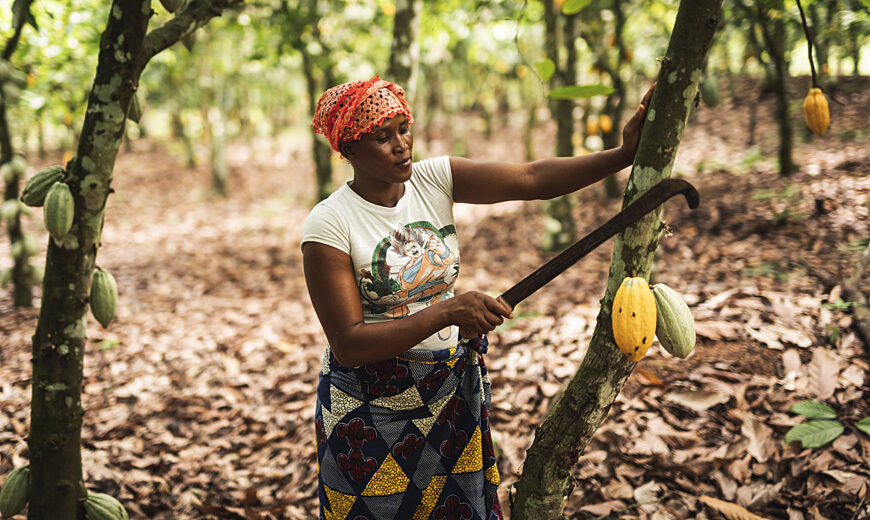
More than 30 developing countries produce cocoa, providing 14 million people with a livelihood.  In some countries of West Africa and Latin America, cocoa production contributes to the majority of household incomes. For instance, in the Ivory Coast and Ghana 90% of the farmers have cocoa production as their primary source of cash earnings. 

Approximately 90% of the world’s cocoa supply is grown and harvested on family-owned farms with plot sizes of 12 acres or less, while only 5% of cocoa is grown on plantations over 40 hectares in size.

No direct access to the market

Many small farmers are unaware of the changing value of their crops. Because of this they are frequently paid much lower than market prices for their harvest by middlemen. Many farmers claim that commercial traders often resort to using distorted scales in order to trick the farmers into thinking their cocoa weighs less than it actually does.  Farmers can therefore receive less revenue for their crops than what even the market levels dictate. 

In fact, the difficulty in making a living of cocoa farming has spawned an increase in child and even slave labour in West African producing countries. In 2001, the International Labour Organization and others reported child slavery on many cocoa farms in the Ivory Coast, source of 43% of the world’s cocoa.

Benefits of Fairtrade for producers

Fairtrade cocoa offers farmers an opportunity to make a real living, as the Fairtrade Standards include a guaranteed minimum price. A Fairtrade Premium is added to the purchase price and is used by cooperatives for social and economic investments such as education, health services, processing equipment and loans to members.

Please click on the link below for comparisons between Fairtrade minimum prices and market prices:

Cocoa Market Price vs. Fairtrade Minimum Price

Also, the FAIRTRADE Certification Mark on a product provides consumers the assurance that no forced or child labour was used in the making of the product.

Fairtrade standards for cocoa

Among other things, Fairtrade standards for cocoa ensure the following:

  • Producers are small family farms organized in cooperatives or associations which they own and govern.
  • The Fairtrade minimum price is paid directly to the producer organizations. The Fairtrade minimum price is currently set at US$1600/metric tonne (MT) for conventional cocoa and US$1750/MT for organic cocoa. When the world market price rises above the Fairtrade minimum price, the market price is paid plus the Fairtrade Premium.
  • A Fairtrade Premium of US$150/MT is paid on top of the purchase price and is used by producer organizations for social and economic investments. If the cocoa is organic certified the Premium is US$200/MT.
  • Environmental standards restrict the use of agrochemicals and encourage sustainability.
  • Pre-harvest lines of credit are given to the cooperatives, if requested, of up to 60% of the purchase price
  • No forced labour of any kind, including child labour.

To find out more about the Fairtrade standards for cocoa production, please download and read the full product standard.

Fairtrade certified producers

Fairtrade cocoa producers are small family farms organized in cooperatives or associations which the farmers own and govern democratically.

You can read a number of case-studies of Fairtrade cocoa producers on the Fairtrade Foundation website.

To find out which cocoa producer organizations are currently Fairtrade certified, you can check the database available on the FLO-CERT website.

Selling Fairtrade cocoa

If you’re interested in selling Fairtrade cocoa in your country, see our information about selling Fairtrade.

Buying products with Fairtrade cocoa

If you want to find out what products are available in your country, visit the website of your national Fairtrade organization.

Latest News

05.06.09

Over 440 European Parliament candidates pledge to support Fair Trade morelink more


04.06.09

Global Fairtrade sales increase by 22% morelink more


Fairtrade videos

Improving the lives of tea workers in India.
Watch the film

Annual Report 2008-09